Chapter 14 Alternative-Specific Multinomial Logit Models
14.1 Introduction: Why Alternative-Specific MNL?
In the last chapter, we modeled brand choice using standard multinomial logit (MNL) models, where all predictors were case-specific. That is, they described the consumer or choice situation and took the same value for all brands in a given choice set.
In many real marketing applications, however, the most important predictors vary by brand. Examples include:
- Price of each brand
- Package size
- Sugar content or nutritional attributes
- Promotional indicators
- Brand-specific features
Alternative-specific multinomial logit (AS-MNL) models allow us to include these variables directly, providing richer managerial insight into how brand attributes drive choice.
In this chapter, you will learn how to:
- Work with long-format choice data
- Split alternative-specific data correctly into training and test samples
- Estimate an alternative-specific MNL model
- Evaluate model fit and classification performance
- Interpret predicted probabilities and marginal effects in a marketing context
Throughout the chapter, we will use the yogurt dataset.
14.2 The Yogurt Choice Data
The yogurt dataset records consumer brand choices in repeated choice situations. Each row represents one alternative within one choice situation, not a single consumer.
Key implications:
- Each choice situation appears multiple times (once per brand)
- Exactly one alternative is chosen per choice set
- Many predictors vary across brands within the same choice set
This “long” structure is required for alternative-specific MNL models and differs from the wide-format data used earlier in the course.
14.3 Preparing the Data for Modeling
14.3.1 Why Splitting Is Different for Choice Data
With alternative-specific data, we cannot randomly split rows into training and test sets. Doing so would break apart choice sets and contaminate model evaluation.
Instead, we must split at the choice-set level, ensuring that all rows belonging to the same choice situation stay together.
14.3.2 Creating Training and Test Samples
We still use the splitsample() function from the MKT4320BGSU package, which supports group-level splitting. Whereas before we didn’t use several parameters, will will use them for alternative specific MNL.
Usage:
splitsample(data, outcome = NULL, group = NULL, choice = NULL, alt = NULL,
p = 0.75, seed = 4320)- where:
datais the data frame to split, in long-format.outcomeis NOT (USUALLY) USED FOR ALTERNATIVE SPECIFIC MNLgroupis the grouping variable (e.g., choice situation id or respondent id). If provided, splitting is done at the group level. Required for alternative specific MNL.choiceis the 0/1 (or TRUE/FALSE) indicator for the chosen alternative. Used only whengroupis provided. Required for alternative specific MNL.altis the optional alternative label/ID. Used withchoiceto stratify at the group level. Required for alternative specific MNL.pis the proportion of observations to place in the training set. Must be strictly between 0 and 1. Default is 0.75.seedis the random seed for reproducibility. Default is 4320.
Before, we were interested in the $train and $test data frames. Now, we are interested in the train.mdata and test.mdata objects that are saved. They are in the format needed for the using mlogit (see below). However, to avoid a console error, you’ll access the a slightly different way.
sp <- splitsample(data = yogurt, group = "id", choice = "choice", alt = "brand")

train <- sp[["train.mdata"]]
test  <- sp[["test.mdata"]]
At this point:
traincontains complete choice sets for model estimationtestcontains unseen choice sets for out-of-sample evaluation
14.4 Specifying an Alternative-Specific MNL Model
In an alternative-specific MNL model:
- Case-specific variables enter once
- Alternative-specific variables enter as brand-varying predictors
We use the mlogit function from the mlogit package to estimate the model. We separate the alternative specific from the case specific variables with a |. Alternative specific come first, then the case specific. We can use the base R summary() function to get the raw log-odds estimates.
library(mlogit)
as_mnl_fit <- mlogit(choice ~ price + feat | income, data = train)
summary(as_mnl_fit)
Call:
mlogit(formula = choice ~ price + feat | income, data = train,
    method = "nr")

Frequencies of alternatives:choice
  Dannon   Hiland   Weight  Yoplait
0.401988 0.029818 0.229155 0.339039

nr method
8 iterations, 0h:0m:0s
g'(-H)^-1g = 0.000171
successive function values within tolerance limits

Coefficients :
                      Estimate Std. Error  z-value  Pr(>|z|)
(Intercept):Hiland   0.7587200  0.5677111   1.3365  0.181401
(Intercept):Weight  -0.0263906  0.2078931  -0.1269  0.898986
(Intercept):Yoplait -3.9886941  0.2679762 -14.8845 < 2.2e-16 ***
price               -0.4424450  0.0295572 -14.9691 < 2.2e-16 ***
feat                 0.4230830  0.1491240   2.8371  0.004552 **
income:Hiland       -0.1081164  0.0149201  -7.2464 4.281e-13 ***
income:Weight       -0.0114764  0.0037707  -3.0436  0.002338 **
income:Yoplait       0.0729207  0.0040281  18.1030 < 2.2e-16 ***
---
Signif. codes:  0 '***' 0.001 '**' 0.01 '*' 0.05 '.' 0.1 ' ' 1

Log-Likelihood: -1618.4
McFadden R^2:  0.23972
Likelihood ratio test : chisq = 1020.6 (p.value = < 2.22e-16)
Interpretation notes:
- Coefficients reflect changes in relative utility
- Signs and magnitudes should be interpreted in marketing terms
- Alternative-specific variables capture within-choice substitution effects
14.5 Evaluating Model Performance
14.5.1 Model Fit and Coefficients
We use the eval_as_mnl() function from the MKT4320BGSU package to obtain fit statistics, coefficients (both log-odds and odds ratio), and classification diagnostics.
Usage:
eval_as_mnl(model, digits = 4, ft = FALSE, newdata = NULL,
label_model = "Model data", label_newdata = "New data", class_digits = 3)- where:
modelis a fitted mlogit model.digitsis an integer; decimals to round coefficient and fit results (default 4).ftis logical; if TRUE, return coefficient and classification tables as flextable objects (default FALSE).newdatais an optionaldfidxobject (e.g.,test.mdata) for an additional classification matrix. If NULL, only the training-data matrix is produced.label_modelis a character string label for the training-data classification matrix (default “Model data”).label_newdatais a character string label for the newdata classification matrix (default “New data”).class_digitsis an integer; decimals to round classification results (default 3).
Key outputs include:
- Log-likelihood \(\chi^2\) test
- McFadden’s pseudo \(R^2\)
- Odds ratios for interpretation
- Classification accuracy and diagnostics
LR chi2 (5) = 1020.5649; p < 0.0001 | |||||
|---|---|---|---|---|---|
McFadden's Pseudo R-square = 0.2397 | |||||
term | logodds | OR | std.error | statistic | p.value |
(Intercept):Hiland | 0.7587 | 2.1355 | 0.5677 | 1.3365 | 0.1814 |
(Intercept):Weight | -0.0264 | 0.9740 | 0.2079 | -0.1269 | 0.8990 |
(Intercept):Yoplait | -3.9887 | 0.0185 | 0.2680 | -14.8845 | 0.0000 |
price | -0.4424 | 0.6425 | 0.0296 | -14.9691 | 0.0000 |
feat | 0.4231 | 1.5267 | 0.1491 | 2.8371 | 0.0046 |
income:Hiland | -0.1081 | 0.8975 | 0.0149 | -7.2464 | 0.0000 |
income:Weight | -0.0115 | 0.9886 | 0.0038 | -3.0436 | 0.0023 |
income:Yoplait | 0.0729 | 1.0756 | 0.0040 | 18.1030 | 0.0000 |
Classification Matrix - Model data | |||||
|---|---|---|---|---|---|
Accuracy = 0.621 | |||||
PCC = 0.330 | |||||
Reference | |||||
Predicted | Dannon | Hiland | Weight | Yoplait | Total |
Dannon | 577 | 39 | 324 | 97 | 1037 |
Hiland | 1 | 12 | 0 | 2 | 15 |
Weight | 18 | 2 | 38 | 18 | 76 |
Yoplait | 132 | 1 | 53 | 497 | 683 |
Total | 728 | 54 | 415 | 614 | 1811 |
Statistics by Class: | |||||
Sensitivity | 0.793 | 0.222 | 0.092 | 0.809 | |
Specificity | 0.575 | 0.998 | 0.973 | 0.845 | |
Precision | 0.556 | 0.800 | 0.500 | 0.728 | |
Classification Matrix - New data | |||||
|---|---|---|---|---|---|
Accuracy = 0.607 | |||||
PCC = 0.331 | |||||
Reference | |||||
Predicted | Dannon | Hiland | Weight | Yoplait | Total |
Dannon | 199 | 14 | 104 | 38 | 355 |
Hiland | 2 | 2 | 1 | 1 | 6 |
Weight | 8 | 1 | 12 | 13 | 34 |
Yoplait | 33 | 0 | 21 | 152 | 206 |
Total | 242 | 17 | 138 | 204 | 601 |
Statistics by Class: | |||||
Sensitivity | 0.822 | 0.118 | 0.087 | 0.745 | |
Specificity | 0.565 | 0.993 | 0.952 | 0.864 | |
Precision | 0.561 | 0.333 | 0.353 | 0.738 | |
14.5.2 Classification Performance
Classification is evaluated at the choice-set level:
- The predicted brand is the one with the highest predicted probability
- Accuracy reflects correct brand predictions
- PCC provides a baseline comparison
This approach mirrors how managers think about predicting actual consumer choices.
14.6 Predicted Probabilities and Marginal Effects
14.6.1 Why Predicted Probabilities Matter
Coefficients are not always intuitive. Predicted probabilities translate the model into outcomes managers care about:
- Market shares
- Brand switching
- Competitive responses
14.6.2 Why Marginal Effects Are Useful
Marginal effects quantify how much choice probabilities change in response to a small change in an attribute, holding everything else constant. Marginal effects can be computed in two common ways:
- At observed values (Average Marginal Effects, AME)
Marginal effects are calculated for each observation using its actual attribute values and then averaged. - At means (Marginal Effects at the Mean, MEM)
Marginal effects are calculated at a single “average” profile, where each attribute is set to its sample mean.
Both approaches summarize how sensitive choice probabilities are to changes in attributes, but they differ in interpretation.
Marginal effects at observed values:
- Reflect the full distribution of the data
- Avoid relying on a potentially unrealistic “average consumer”
- Are often preferred for descriptive and policy interpretation
Marginal effects at means:
- Are easier to reproduce by hand or with software defaults
- Provide a clear, single reference point
- Can be useful for illustrating model mechanics and comparing effects across variables
The marginal effects tables can therefore answer questions such as:
- “On average, how does a $1 increase in price affect brand choice?”
- “How would choice probabilities change for a typical consumer if an attribute increased slightly?”
- “Which brands are most sensitive to changes in a specific attribute?”
In practice, the choice between observed values and means depends on the goal of the analysis. For interpretation and real-world impact, average marginal effects at observed values are often preferred. For teaching, demonstration, or simplified comparisons, marginal effects at means can be equally informative.
14.6.3 The pp_as_mnl() Function
For both case-specific and alternative-specific predictors, we use the pp_as_mnl() function from the MKT4320BGSU package to get both predicted probabilities and marginal effects.
Usage:
pp_as_mnl(model,focal_var, focal_type = c("auto", "alt", "case"),
grid_n = 25, digits = 4, ft = FALSE, marginal = TRUE,
me_method = c("observed", "means"), me_step = 1)- where:
modelis a fitted mlogit model.focal_varis a character string name of the focal variable.focal_typeis a character string; one of “case”, “alt”, or “auto” (default = “auto”).grid_nis an integer; number of points used to construct the grid of focal values for predicted probability plots when the focal variable is continuous (default = 25).digitsis an integer; rounding for numeric output (default = 4).ftis logical; if TRUE, return tables as flextable objects (default = FALSE).marginalis logical; if TRUE, compute marginal effects (default = TRUE).me_methodis a character string; one of “observed” AME or “means” (default = “observed”).me_stepis numeric; finite-difference step size for AME (default = 1).
14.6.4 Case-Specific Predictors
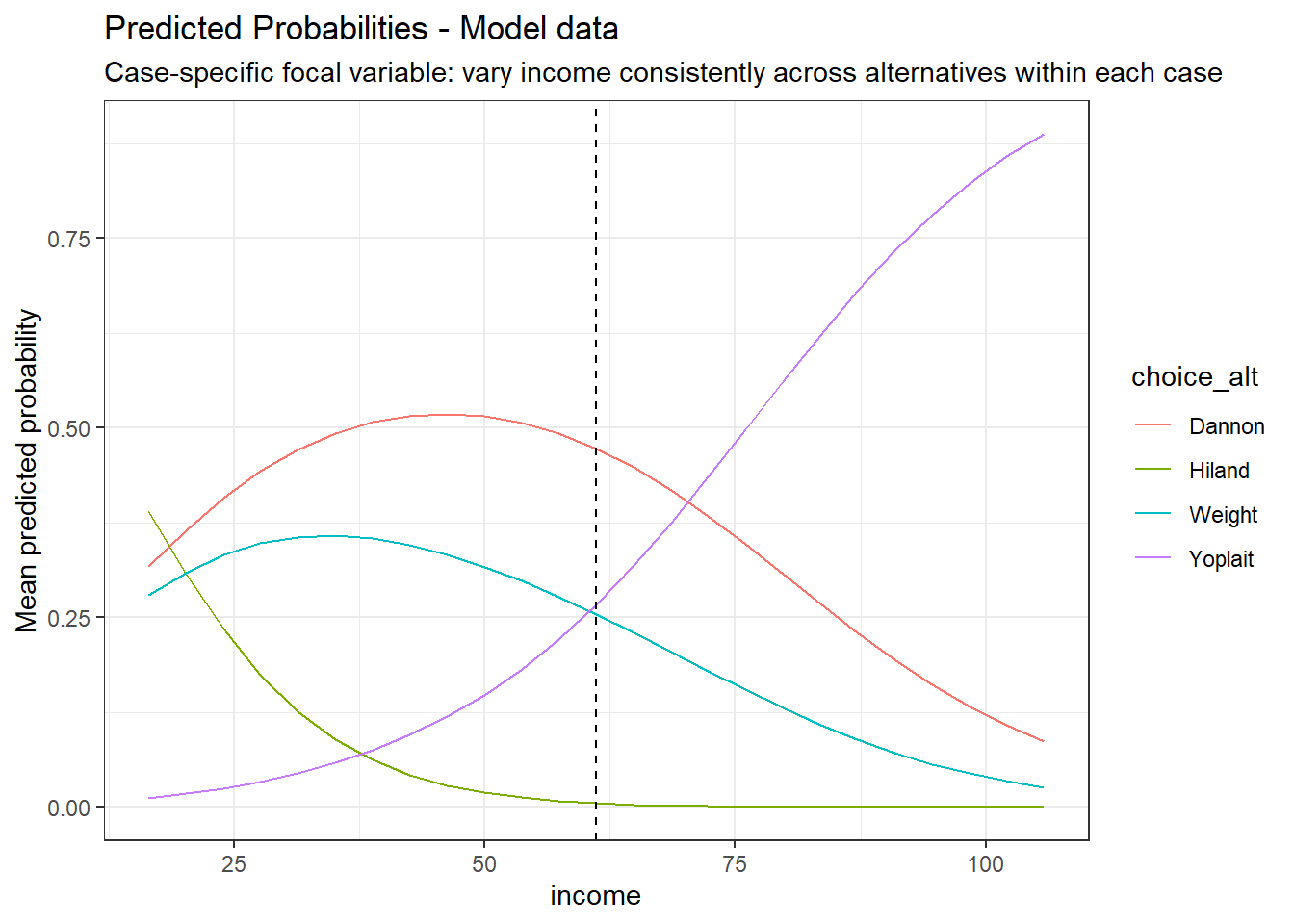
We first examine how a consumer-level variable affects brand choice probabilities.
pp_income <- pp_as_mnl(as_mnl_fit, focal_var = "income", ft = TRUE, me_method="means")
pp_income$me_table
Marginal effects for income (at means) | |||
|---|---|---|---|
Dannon | Hiland | Weight | Yoplait |
-0.0073 | -0.0006 | -0.0068 | 0.0147 |
Predicted Probability Table (income) - Model data | ||||
|---|---|---|---|---|
focal_value | Dannon | Hiland | Weight | Yoplait |
60.1438 | 0.4788 | 0.0060 | 0.2608 | 0.2544 |
61.1438 | 0.4729 | 0.0053 | 0.2545 | 0.2672 |
62.1438 | 0.4667 | 0.0047 | 0.2482 | 0.2804 |
Because income is continuous, the values shown include the mean and +/- 1 unit. | ||||
14.6.5 Alternative-Specific Predictors
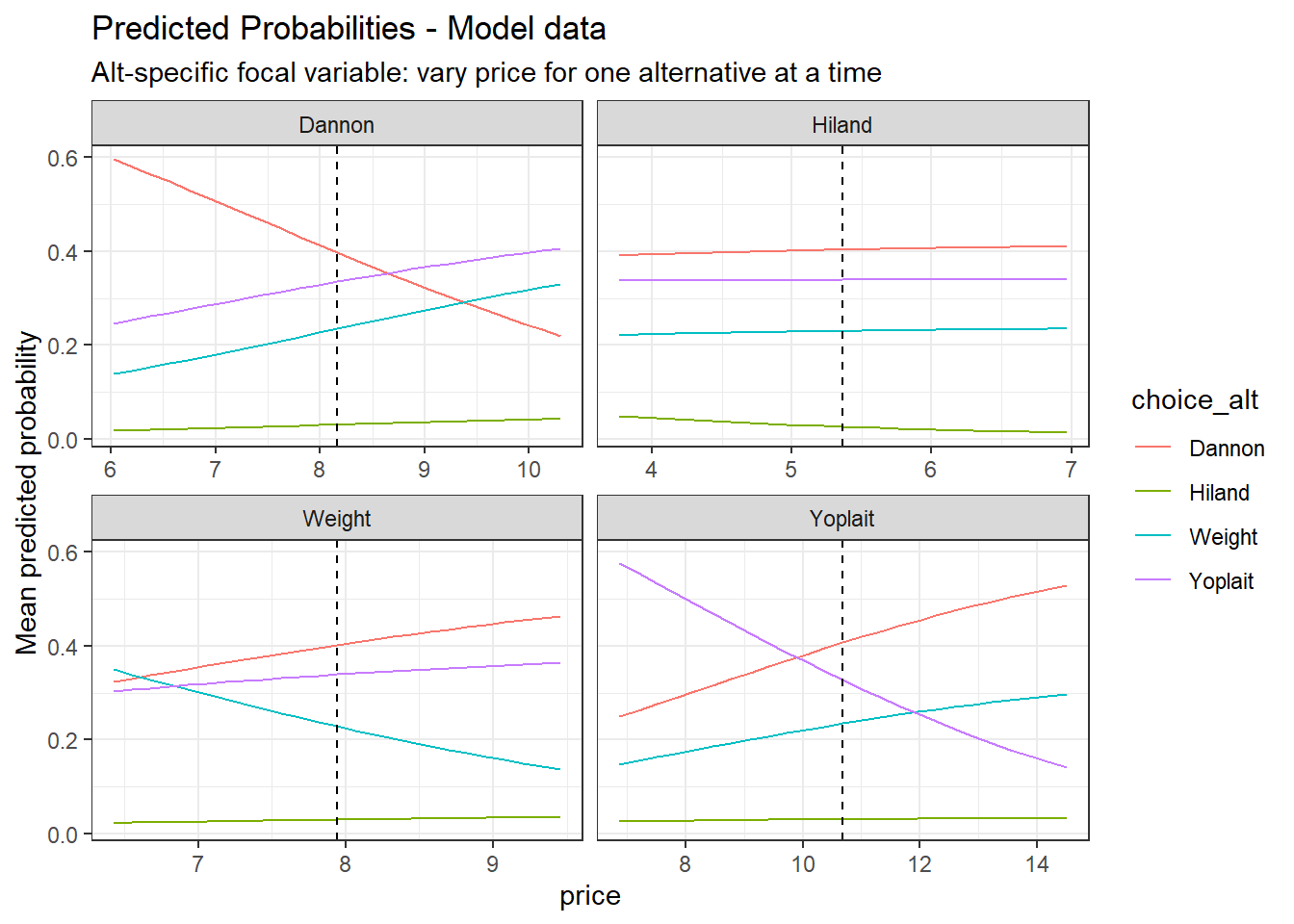
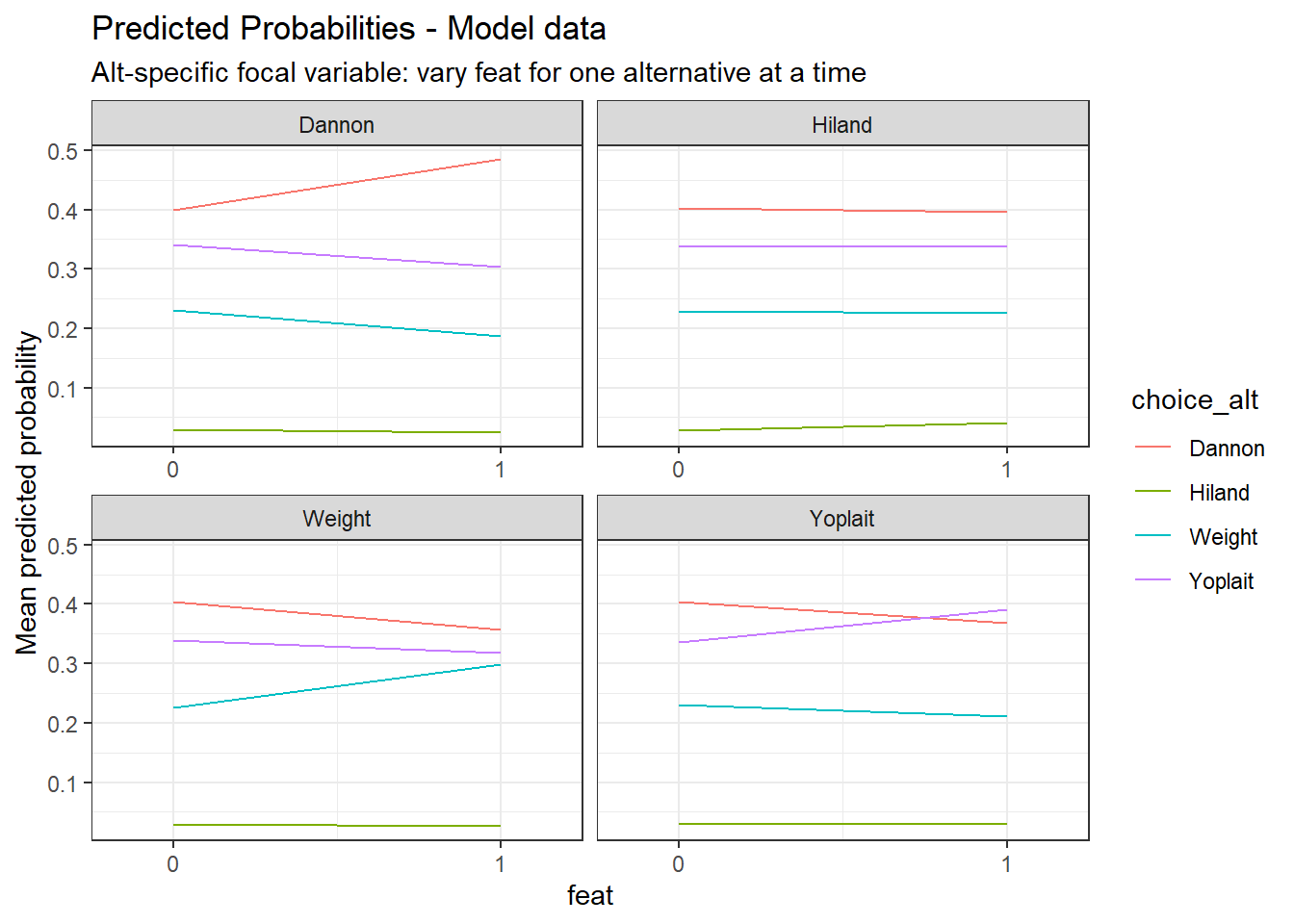
Now we examine a brand-specific variable such as price (a continuous variable) and feature (a categorical variable).
pp_price <- pp_as_mnl(as_mnl_fit, focal_var = "price", ft=TRUE, me_method="means")
pp_price$me_table
Marginal effects for price (at means) | ||||
|---|---|---|---|---|
Alternative | Dannon | Hiland | Weight | Yoplait |
Dannon | -0.1105 | 0.0010 | 0.0550 | 0.0545 |
Hiland | 0.0010 | -0.0021 | 0.0005 | 0.0005 |
Weight | 0.0550 | 0.0005 | -0.0845 | 0.0290 |
Yoplait | 0.0545 | 0.0005 | 0.0290 | -0.0840 |
Predicted Probability Table (price) - Model data | |||||
|---|---|---|---|---|---|
varied_alt | focal_value | Dannon | Hiland | Weight | Yoplait |
Dannon | 7.1628 | 0.4918 | 0.0250 | 0.1883 | 0.2949 |
Dannon | 8.1628 | 0.3980 | 0.0313 | 0.2353 | 0.3355 |
Dannon | 9.1628 | 0.3088 | 0.0375 | 0.2821 | 0.3716 |
Hiland | 4.3663 | 0.3966 | 0.0394 | 0.2258 | 0.3382 |
Hiland | 5.3663 | 0.4035 | 0.0268 | 0.2305 | 0.3392 |
Hiland | 6.3663 | 0.4083 | 0.0179 | 0.2338 | 0.3399 |
Weight | 6.9421 | 0.3516 | 0.0256 | 0.3060 | 0.3169 |
Weight | 7.9421 | 0.4019 | 0.0301 | 0.2287 | 0.3392 |
Weight | 8.9421 | 0.4446 | 0.0340 | 0.1648 | 0.3566 |
Yoplait | 9.6874 | 0.3673 | 0.0302 | 0.2138 | 0.3886 |
Yoplait | 10.6874 | 0.4069 | 0.0311 | 0.2350 | 0.3269 |
Yoplait | 11.6874 | 0.4438 | 0.0318 | 0.2545 | 0.2699 |
Because price is continuous, the values shown include the mean and +/- 1 unit. | |||||
Marginal effects for feat (at means) | ||||
|---|---|---|---|---|
Alternative | Dannon | Hiland | Weight | Yoplait |
Dannon | 0.1057 | -0.0010 | -0.0526 | -0.0521 |
Hiland | -0.0010 | 0.0020 | -0.0005 | -0.0005 |
Weight | -0.0526 | -0.0005 | 0.0808 | -0.0277 |
Yoplait | -0.0521 | -0.0005 | -0.0277 | 0.0804 |
Predicted Probability Table (feat) - Model data | |||||
|---|---|---|---|---|---|
varied_alt | focal_value | Dannon | Hiland | Weight | Yoplait |
Dannon | 0 | 0.3988 | 0.0301 | 0.2308 | 0.3403 |
Dannon | 1 | 0.4853 | 0.0244 | 0.1870 | 0.3033 |
Hiland | 0 | 0.4027 | 0.0285 | 0.2297 | 0.3391 |
Hiland | 1 | 0.3960 | 0.0407 | 0.2251 | 0.3381 |
Weight | 0 | 0.4038 | 0.0300 | 0.2264 | 0.3398 |
Weight | 1 | 0.3565 | 0.0257 | 0.2990 | 0.3188 |
Yoplait | 0 | 0.4043 | 0.0299 | 0.2306 | 0.3352 |
Yoplait | 1 | 0.3681 | 0.0289 | 0.2112 | 0.3918 |
Because feat is binary, only the two observed values are shown. | |||||
14.7 Managerial Insights
Alternative-specific MNL models allow managers to:
- Evaluate pricing and promotion strategies
- Understand competitive substitution patterns
- Predict market share changes under different scenarios
Compared to standard MNL models, AS-MNL models provide more realistic insights when brand attributes vary within choice sets.